
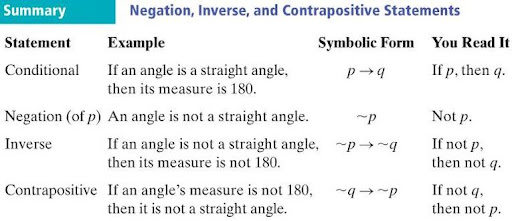
In mathematics, we often want to prove statements of the form , which reads “ implies .” Such a statement is true if is true whenever is true, that is, when being true “forces” to be true. An alternate but equivalent statement is the contrapositive , which states that being false implies that is false. This is useful because there are many times in which it is easier to prove the contrapositive of a statement rather than the statement itself. To show this, we’ll look at the following example:
if the square of an integer is even, then the integer must be even
Let be an arbitrary integer. The direct approach would be to show that if for some integer ( is even), then for some integer ( is even). The problem is that it’s hard to work from back to when dealing with integers because “just taking the square root” don’t give you the structural information you need to prove statements. Instead, it will be much easier to prove the contrapositive: if an integer is odd, then its square must be odd. Working from this direction, the proof boils down to some simple multiplication: If for some integer ( is odd), then
which shows that is odd. This is an example of how the most obvious or direct solution isn’t always the best one. Sometimes things click into place much easier when you look at them from another perspective.
Resources
- “Contraposition.” Wikipedia, 18 Nov. 2021, en.wikipedia.org/wiki/Contraposition. Accessed 8 Mar. 2026.
- Zeihen, Andy. “Lesson 5-4 Negation with Inverse and Contrapositive Statements.” Zeihen RMHS 605, 2026, www.zeihen.com/lesson-5-4-negation-with-inverse-and-contrapositive-statements.html. Accessed 8 Mar. 2026.
Leave a Reply