
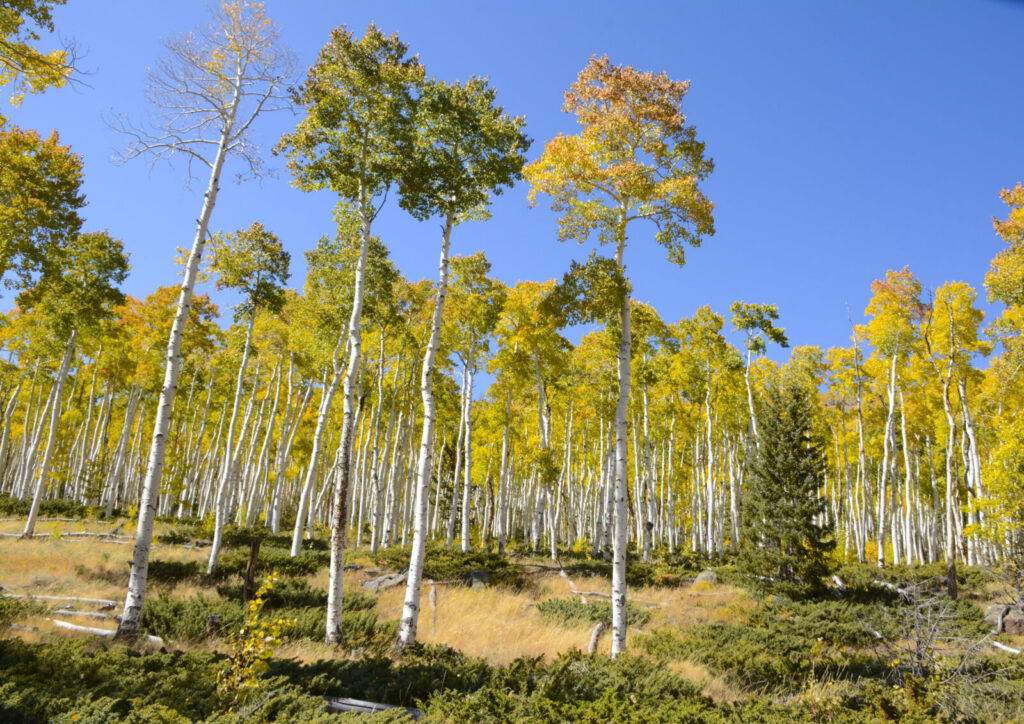
High in the mountains of central Utah stands what looks like a typical forest of quaking aspen. But appearances are deceiving. Known as Pando, this grove is not a forest of separate trees—it’s one single organism.
Located within the Fishlake National Forest, Pando consists of roughly 47,000 genetically identical quaking aspen stems spread across about 100 acres. Each trunk you see rising from the ground is not an individual tree but a shoot growing from a vast, shared underground root system. Because all the stems are genetically identical and connected, scientists classify Pando as a single clonal organism.
What makes Pando remarkable is not just its size but its age. Researchers estimate the root system may be around 10,000 years old, making it one of the oldest known living organisms on Earth. While individual trunks typically live for about 100–130 years before dying and being replaced, the root network continues to send up new stems, allowing the organism to persist for millennia.
The name “Pando” comes from Latin, meaning “I spread.” It is an appropriate description. Over thousands of years, the root system has gradually expanded, sending up new growth and slowly covering more ground.
Pando is also one of the heaviest known living organisms, with an estimated weight of more than 13 million pounds. That mass is mostly hidden underground in the root system that connects every stem in the grove.
Despite its resilience, Pando faces modern challenges. Reduced regeneration from grazing deer and livestock, combined with environmental stress, has slowed the growth of new stems in parts of the grove. Scientists and land managers are now studying ways to protect and restore this ancient organism.
At first glance, Pando looks like a quiet stand of aspens trembling in the Utah breeze. In reality, it is something far rarer: a single living being that has quietly endured since the end of the last Ice Age.
Resources
- Harmon, Matt. “Unforgettable Experiences: Pando Aspen Clone.” 1, www.nationalforests.org/blog/unforgettable-experiences-pando-aspen-clone. Accessed 15 Mar. 2026.
- “Pando (Tree).” Wikipedia, 11 May 2021, en.wikipedia.org/wiki/Pando_(tree). Accessed 15 Mar. 2026.
Leave a Reply